
Fire sprinkler systems work by detecting high heat from a fire and releasing water over the affected area. In most systems, sprinkler heads activate individually, meaning one sprinkler can open without setting off every sprinkler in the building.
That is the short answer.
A fire sprinkler system is made to control a fire early, protect people inside the building, and reduce property damage before the fire grows. It does this through a network of pipes, sprinkler heads, valves, water supply connections, and alarm components.
For homes, commercial buildings, restaurants, warehouses, offices, and multi-family properties, a working sprinkler system can make the difference between a controlled incident and a major loss. If your property needs installation, inspection, repairs, or maintenance, LHR Fire Protection provides fire sprinkler services for homes and businesses across New Hampshire, northern Massachusetts, and southern Maine.
How Does a Fire Sprinkler System Work?
A fire sprinkler system responds to heat.
When a fire starts, hot air rises. Once the temperature near a sprinkler head gets high enough, the heat-sensitive part of the sprinkler activates. This is usually a glass bulb filled with liquid or a metal fusible link.
Once that part breaks or releases, the sprinkler head opens and water flows onto the fire.
Here’s the basic process:
- A fire creates rising heat.
- The sprinkler head reaches its activation temperature.
- The glass bulb or fusible link releases.
- Water flows through the open sprinkler head.
- The system helps control or suppress the fire.
- The fire alarm or monitoring system may alert occupants or emergency responders, depending on how the system is set up.
Sprinklers are often misunderstood. They do not usually activate because of smoke, burnt toast, steam, or someone pulling a fire alarm. They respond to heat from a real fire.
For a deeper look at how sprinkler systems are installed and how they respond during a fire, you can also read LHR’s guide on fire sprinkler installation and fire detection.
Do All Fire Sprinklers Go Off at Once?
No. In most fire sprinkler systems, all sprinkler heads do not activate at the same time.
Usually, only the sprinkler head closest to the fire opens. If the fire spreads and creates enough heat in another area, additional sprinkler heads may activate.
This matters because people often imagine movie-style sprinkler scenes where every head in the building goes off at once. That is not how most systems work.
The goal is targeted water discharge where the heat is highest. That helps control the fire while limiting unnecessary water damage.
What Are the Main Parts of a Fire Sprinkler System?
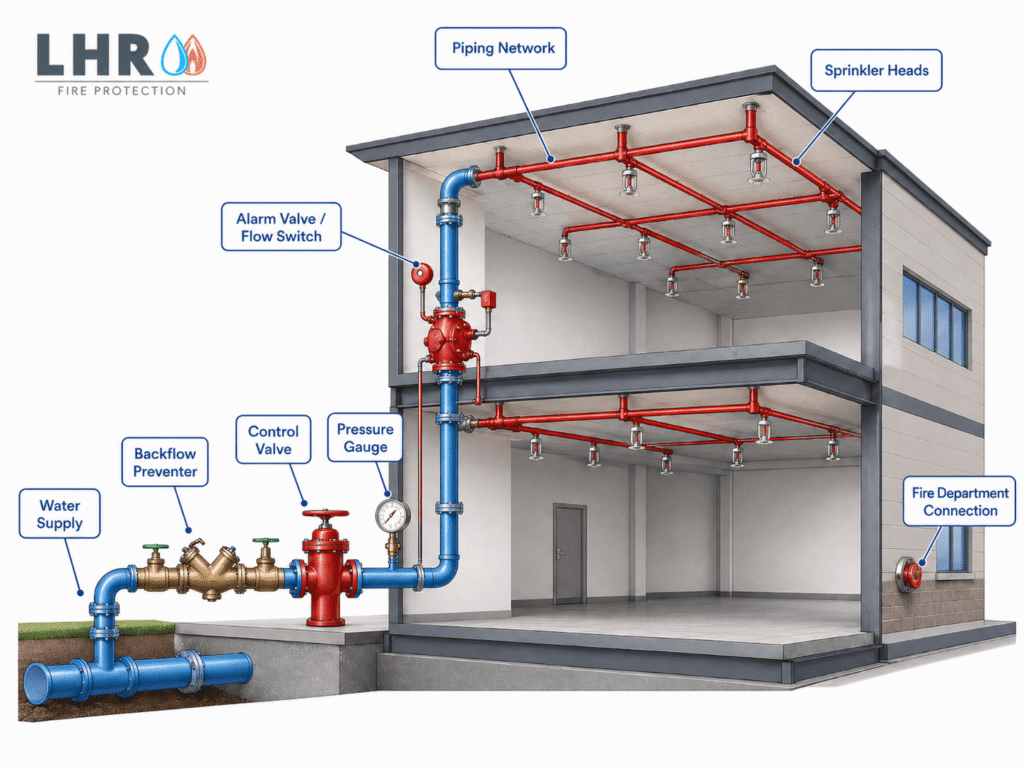
A fire sprinkler system is more than the sprinkler heads you see on the ceiling.
The main parts usually include:
- Water supply – the source that feeds the system
- Piping network – the pipes that carry water through the building
- Sprinkler heads – the devices that release water when activated by heat
- Control valves – valves that manage water flow
- Alarm valve or flow switch – components that help trigger an alarm when water moves
- Pressure gauges – devices that show system pressure
- Backflow preventer – equipment that helps protect the water supply
- Fire department connection – an exterior connection firefighters may use to support the system
For commercial properties, these components need regular inspection and testing. A sprinkler system may look fine from the outside but still have pressure issues, closed valves, damaged heads, corrosion, leaks, or hidden obstructions.
If your building has not been checked recently, scheduling fire sprinkler inspection and maintenance can help catch issues before they turn into safety problems, code violations, or costly emergency repairs.
Main Types of Fire Sprinkler Systems
Different buildings need different sprinkler systems. The right system depends on the property, temperature conditions, fire risk, building use, and code requirements.
The four main types are:
- Wet pipe sprinkler systems
- Dry pipe sprinkler systems
- Pre-action sprinkler systems
- Deluge sprinkler systems
Each one works differently.
For a broader overview of system options for residential and commercial properties, LHR also has a helpful fire sprinkler system guide.
Wet Pipe Fire Sprinkler Systems
A wet pipe sprinkler system is the most common type.
In this system, water is always inside the pipes. When a sprinkler head activates, water discharges immediately.
Wet pipe systems are common in heated buildings such as offices, apartment buildings, schools, retail spaces, and many commercial properties.
The main benefit is speed. Since the pipes already contain water, the system can respond quickly once a sprinkler head opens.
However, wet pipe systems are not ideal for areas exposed to freezing temperatures. If water inside the pipes freezes, it can expand, crack pipes, damage fittings, or prevent the system from working properly.
That is especially important for properties in New Hampshire, northern Massachusetts, and southern Maine, where winter conditions can create real sprinkler system risks.
Dry Pipe Fire Sprinkler Systems
A dry pipe sprinkler system is used in areas where pipes may be exposed to freezing temperatures.
Instead of holding water in the pipes, the system holds pressurized air or nitrogen. When a sprinkler head opens, the air pressure drops. That opens the dry pipe valve and allows water to enter the pipes and flow out through the activated sprinkler.
Dry pipe systems are often used in:
Unheated warehouses
Parking garages
Loading docks
Attics
Cold storage areas
Exterior canopies
Buildings with freeze-prone sections
The main advantage is freeze protection. The tradeoff is that water delivery may take slightly longer than in a wet pipe system because water has to travel through the piping after the valve opens.
If freezing conditions are a concern for your property, LHR’s article on fire sprinkler maintenance in NH and MA explains why winter maintenance is so important.
What Is a Pre-Action Fire Sprinkler System?
A pre-action fire sprinkler system is a sprinkler system that requires an additional detection step before water enters the pipes.
In many pre-action systems, a fire detection device must activate first. Then the system allows water into the piping. After that, water only discharges if a sprinkler head opens from heat.
Pre-action systems are often used where accidental water discharge could cause serious damage.
Common examples include:
Data rooms
Server rooms
Museums
Archives
Libraries
Laboratories
High-value storage areas
Sensitive equipment rooms
This type of system gives an added layer of control. It is useful in spaces where water damage could be costly, but reliable fire protection is still required.
Pre-action systems are more complex than standard wet pipe systems, so inspection and maintenance are especially important.
Deluge Fire Sprinkler Systems
A deluge system uses open sprinkler heads. Unlike standard sprinkler heads, they do not have heat-sensitive bulbs or fusible links keeping them closed.
When the detection system activates, the deluge valve opens and water flows through all open heads in the protected area.
Deluge systems are used in high-hazard environments where fire can spread quickly.
These may include:
Industrial facilities
Chemical storage areas
Aircraft hangars
Power plants
Certain manufacturing spaces
A deluge system is not the standard choice for most offices, homes, or small commercial spaces. It is made for high-risk areas where fast, heavy water discharge may be needed.
When Is a Fire Sprinkler System Required?
A fire sprinkler system may be required depending on the building type, occupancy, size, height, use, renovation scope, and local fire code.
There is no single answer that applies to every property.
Sprinkler requirements can vary for:
Commercial buildings
Multi-family housing
Restaurants
Industrial buildings
Warehouses
Schools
Healthcare facilities
Mixed-use buildings
New construction projects
Major renovations or change-of-use projects
Local code officials and the Authority Having Jurisdiction, often called the AHJ, play a major role in determining what is required for a specific building.
In New Hampshire, fire code requirements are tied to adopted codes such as NFPA 1 and NFPA 101. Local municipalities may also have their own review processes, permits, and plan requirements.
That means property owners should avoid guessing.
If you are opening a business, renovating a building, changing occupancy, expanding a space, or buying a commercial property, it is best to have the sprinkler requirements reviewed early. Waiting until the end of a project can lead to delays, redesigns, failed inspections, or unexpected costs.
For related guidance, LHR’s article on fire safety compliance explains why property owners need to stay ahead of inspection, testing, and documentation requirements.
How Much Does a Fire Sprinkler System Cost?
The cost of a fire sprinkler system depends on the building and the type of system needed.
There is no flat price that works for every property because sprinkler systems are built around the structure they protect.
Major cost factors include:
Building size
Number of floors
Ceiling height
System type
New construction vs. retrofit
Water supply conditions
Pipe layout
Local permitting requirements
Fire pump needs
Backflow prevention requirements
Building use and hazard level
Accessibility for installation
Inspection and testing needs
A simple wet pipe system in a straightforward building will usually cost less than a complex pre-action, dry pipe, or deluge system.
Retrofit projects can also cost more than new construction because technicians may need to work around existing ceilings, walls, utilities, tenants, or business operations.
For commercial properties, the best way to estimate cost is to schedule a review. A fire protection contractor can look at the building, code requirements, water supply, and system design needs before giving a more accurate quote.
LHR Fire Protection can help property owners understand the right system for their building through professional fire sprinkler installation and service support.
Fire Sprinkler Installation vs. Inspection vs. Maintenance
Fire sprinkler work usually falls into three main categories: installation, inspection, and maintenance.
Fire Sprinkler Installation
Installation is needed for new systems, building additions, renovations, or spaces that now require sprinkler protection.
This can include:
System design
Pipe installation
Sprinkler head placement
Valve setup
Water supply connection
Fire department connection
Testing and approval support
Fire Sprinkler Inspection
Inspection checks whether the system is in proper working condition.
A sprinkler inspection may include checking:
Control valves
Gauges
Water pressure
Sprinkler heads
Visible piping
Alarm connections
Fire department connections
Signs of leaks, corrosion, or damage
For commercial buildings, inspection records are important. They may be requested by fire officials, insurance providers, property managers, or building owners.
To understand why inspections matter beyond basic compliance, read LHR’s article on how a fire system inspection can help protect both people and property.
Fire Sprinkler Maintenance
Maintenance covers repairs and service work that keeps the system reliable.
This may include:
Replacing damaged sprinkler heads
Fixing leaks
Addressing pressure issues
Repairing valves
Servicing dry pipe systems
Winterizing freeze-prone areas
Correcting inspection deficiencies
A sprinkler system should not be ignored until something breaks. Small issues can become expensive problems if they are missed for too long.
Common Fire Sprinkler System Problems
Even a well-installed system needs ongoing care.
Common sprinkler system problems include:
Closed or partially closed control valves
Low water pressure
Corroded pipes
Damaged sprinkler heads
Painted sprinkler heads
Leaking fittings
Frozen pipes
Obstructed sprinkler heads
Outdated system components
Missing inspection records
Trouble signals from connected alarm equipment
Some problems are visible. Others are not.
That is why routine inspection matters. A system may look normal from the outside but still have issues that affect performance during a fire.
If your building has an active alarm panel connected to sprinkler monitoring, it is also important to keep the alarm system in good condition. LHR provides fire alarm services to help properties maintain reliable life safety systems.
Why Fire Sprinkler Systems Matter for Property Owners
A fire sprinkler system is not just a code requirement. It is part of a larger life-safety plan.
For property owners and facility managers, a working system can help:
Protect building occupants
Reduce fire damage
Limit business interruption
Support insurance requirements
Help satisfy fire code obligations
Protect inventory, equipment, and property
Give firefighters more control when they arrive
For restaurants, warehouses, offices, apartment buildings, and commercial properties, fire protection is not something to handle at the last minute.
A sprinkler system needs to be installed correctly, inspected on schedule, and maintained by qualified professionals.
Need Help With a Fire Sprinkler System in NH, MA, or ME?
LHR Fire Protection installs, inspects, repairs, and maintains fire sprinkler systems for residential and commercial properties.
Whether you need a new sprinkler system, an annual inspection, emergency sprinkler repair, or help understanding your fire protection requirements, our team can review your property and recommend the right next step.
We serve New Hampshire, northern Massachusetts, and southern Maine with local, reliable fire protection service.
Contact LHR Fire Protection today to schedule fire sprinkler service or request a quote.
FAQs About Fire Sprinkler Systems
How does a fire sprinkler work?
A fire sprinkler works by responding to heat. When the temperature near the sprinkler head gets high enough, the heat-sensitive element activates and allows water to flow over the fire.
Do fire sprinklers detect smoke?
No. Fire sprinklers are generally activated by heat, not smoke. Smoke alarms detect smoke, while sprinkler heads respond to high temperatures near the ceiling.
Do all fire sprinklers go off at once?
In most systems, no. Usually, only the sprinkler head closest to the fire activates. Other heads may open only if the fire spreads and creates enough heat in those areas.
What is a pre-action fire sprinkler system?
A pre-action fire sprinkler system uses an added detection step before water enters the pipes. It is often used in spaces where accidental water discharge could damage sensitive equipment or valuable materials.
When is a fire sprinkler system required?
A fire sprinkler system may be required based on building size, use, occupancy, height, renovation scope, and local fire code. The local Authority Having Jurisdiction can determine what is required for a specific property.
How much does a fire sprinkler system cost?
The cost depends on building size, system type, water supply, pipe layout, local requirements, and whether the project is new construction or a retrofit. A site review is the best way to get an accurate estimate.
How often should fire sprinkler systems be inspected?
Inspection frequency depends on the system type, building use, and applicable code requirements. Many commercial systems need routine inspections and testing throughout the year, with documentation kept for compliance.